| dc.contributor.author | Mazalina Ali, Mohammad Faisal Md. Saleh, Hamizah Nadia Alias @ Yusof, Muhammad Amirullah Al Amin Ayob, Khairiah Jaafar | |
| dc.contributor.editor | Mazalina Ali, Mohammad Faisal Md. Saleh, Hamizah Nadia Alias @ Yusof, Muhammad Amirullah Al Amin Ayob, Khairiah Jaafar | |
| dc.coverage.spatial | Subang Jaya | en |
| dc.date.accessioned | 2025-12-22T01:03:56Z | |
| dc.date.available | 2025-12-22T01:03:56Z | |
| dc.date.issued | 2025-12-22 | |
| dc.identifier.citation | Mazalina, A., Mohammad Faisal, M.S, Hamizah Nadia, A.Y., Muhammad Amirullah Al- Amin, A., and Khairiah, J. 2025. Report on the Regional Technical Consultation on The Harmonization of Simple and Practical Indicators for Sustainable Pelagic Fisheries in Southeast Asia, 22 – 24 October 2025, Subang, Malaysia. SEAFDEC/ MFRDMD/RM/53. 107 pp | en |
| dc.identifier.isbn | 978-629-7629-17-9 | |
| dc.identifier.uri | http://hdl.handle.net/20.500.12561/2957 | |
| dc.description | Pelagic fisheries play a vital role in the socio-economic and food security landscape of Southeast Asia, contribute significantly to the total marine capture fisheries production in the region. These species form the backbone of many coastal and island communities’ livelihoods and are integral to regional and international seafood trade. Pelagic fisheries consistently contributed approximately 45–60% of the total marine capture fisheries production in Southeast Asia. Countries such as Indonesia, Philippines, Thailand, and Viet Nam are among the largest producers, contributing substantial volumes of pelagic fish both for domestic consumption and export markets. In recent years, the region has seen an increase in demand for pelagic species, driven by population growth, changing consumption patterns, and international market pressures.
The sustainability of pelagic fisheries in Southeast Asia is under growing pressure due to overfishing, illegal, unreported and unregulated (IUU) fishing, habitat degradation, climate change, and limited management capacity. The transboundary nature of many pelagic fisheries, coupled with disparities in data collection and monitoring among ASEAN Member States (AMSs), further complicates effective regional management. In response, regional and international frameworks have emphasized the importance of using indicators to assess the status and sustainability of fisheries. However, many existing indicators are overly complex or lack harmonization, limiting their practical application. | en |
| dc.description.abstract | RTC marks the next phase, which is on third output of the project, ‘Simple and practical indicators are standardized in supporting the planning and monitoring of sustainable fisheries of pelagic fish’. The main purpose of this three-day RTC Meeting is to share information on the indicators used by AMSs for sustainability of pelagic fish resources. The Regional Guidelines for Responsible Fisheries in Southeast Asia under the area of Fisheries Management has mentioned about indicators. Indicator is a performance-based variable, measure or index that provides information on the condition and status of fisheries resources. Indicators in pelagic fisheries management could be on biological and population indicators, ecosystem and environmental indicators, and management and performance indicators. | en |
| dc.description.sponsorship | This publication has been funded by the Japan-ASEAN Integration Fund (JAIF) through the Implementation and Assessment of the ASEAN Regional Plan of Action for the Management of Fishing Capacity project. The views expressed in this publication are the author’s alone and are not necessarily the views of the Government of Japan, ASEAN Member States, and the ASEAN Secretariat. | en |
| dc.format.extent | 107p. : col. ill. ; 29.5cm. | en |
| dc.language.iso | en | en |
| dc.publisher | Marine Fishery Resources Development and Management Department | en |
| dc.relation.ispartofseries | Pelagic Fish Resources;SEAFDEC/ MFRDMD/RM/53 | |
| dc.subject | pelagic, fisheries, resources, regional technical | en |
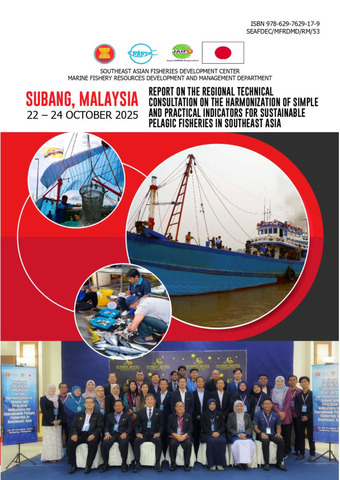
| dc.title | Report on the Regional Technical Consultation on The Harmonization of Simple and Practical Indicators for Sustainable Pelagic Fisheries in Southeast Asia | en |
| dc.type | Book | en |