
Shark-based sensors could tell of coming storms
Associated URL
www-pressreader-com.eresources.u-library.gov.my:2443Date
2026-08-10Metadata
Show full item recordAbstract
From the killer shark of Jaws to the tornado-tossed predators of the Sharknado movies, films long have portrayed sharks as objects of summer fear.
Description
Dover (Delaware): From the killer shark of Jaws to the tornado-tossed predators of the Sharknado movies, films long have portrayed sharks as objects of summer fear.
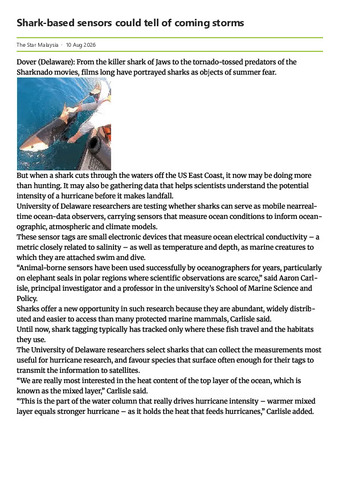
But when a shark cuts through the waters off the US East Coast, it now may be doing more than hunting. It may also be gathering data that helps scientists understand the potential intensity of a hurricane before it makes landfall.
University of Delaware researchers are testing whether sharks can serve as mobile nearreal-time ocean-data observers, carrying sensors that measure ocean conditions to inform oceanographic, atmospheric and climate models.
These sensor tags are small electronic devices that measure ocean electrical conductivity – a metric closely related to salinity – as well as temperature and depth, as marine creatures to which they are attached swim and dive.
“Animal-borne sensors have been used successfully by oceanographers for years, particularly on elephant seals in polar regions where scientific observations are scarce,” said Aaron Carlisle, principal investigator and a professor in the university’s School of Marine Science and Policy.
Sharks offer a new opportunity in such research because they are abundant, widely distributed and easier to access than many protected marine mammals, Carlisle said.
Until now, shark tagging typically has tracked only where these fish travel and the habitats they use.
The University of Delaware researchers select sharks that can collect the measurements most useful for hurricane research, and favour species that surface often enough for their tags to transmit the information to satellites.
“We are really most interested in the heat content of the top layer of the ocean, which is known as the mixed layer,” Carlisle said.
“This is the part of the water column that really drives hurricane intensity – warmer mixed layer equals stronger hurricane – as it holds the heat that feeds hurricanes,” Carlisle added.
Type
newspaperArticleSubject
Collections
- 2026 [61]